Showing posts with label Track Plan. Show all posts

Monday, 10 July 2023

Modular layout trackplan

Funny how these things go. I meant to make this post a month and a half ago, but time somehow gets away from one so. 

I've been using the free version of AnyRail to design the layout for the modules. The area on each module for track laying is 550mm x 1200mm. 

As always there are some compromises in any track plan. 

Some things I wanted to achieve:
  • I really like point-to-point operations, 
  • I prefer not to handle the locomotives, so turntables and engine houses are required.
  • Trains up to 1.45 meters long (two locomotives and 6 passenger cars) need to be accommodated.
  • Yard tracks need to be double-ended (for locomotives to escape).
  • All rolling stock must be able to be stored on the layout, including:
    • A caboose track for storing cabeese.
    • Maintenance of way equipment track.
  • To achieve the above and save space, I'm happy with a non-prototype, fiddle-yard track design at one end. Although, this will still be finished with scenery.
  • The track must be mostly level across all modules, save for small changes between different sorts of tracks. The scenery will rise above and drop below the tracks on some modules to give a sense of the landscape.
  • I want several modules to just feature a single track and large landscapes.
  • Two types of bridges, one of which should be a timber trestle.
  • At least one tunnel. (The previous layout used a lot of tunnels and I want to reduce the level of hidden trackage).
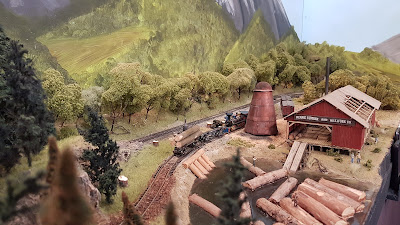
  • I want a passing siding between the two towns for meets. This is a location to include the large redwood trees and some industries like the sawmill and mine.
  • Provisions for locomotive servicing at each end. 
 
The design below is what I've come up with so far. The benchwork for the four modules along the top of the picture has been constructed and after laying out the printed track plan and testing the space with my rolling stock, I've started laying track for the yard area. The modules along the right side of the picture and bottom, are a concept only and will be constructed in the future. 

Any tips, suggestions or comments on the track plan are welcome, so feel free to leave a comment. I'll endeavour to reply


Monday, 31 December 2018

Whats the intent?


Galen Gallimore runs a great blog over at http://ocalicreek.blogspot.com/. Recently, Galen made a thoughtful post titled "Whats the intent?". In turn, his post had been inspired by a post on Mike Cougill's blog at http://www.ostpubs.com/whats-the-intent/. Their posts explored the rationale behind what we are trying to achieve with our model railroads. Galen issued a challenge for other modelers to share their thoughts about the intent behind their layouts so this is some of my thinking for my Thoroughfare Gap Railroad.

My decision to model the 1890's was very intentional. From the outset, I intended for my railroad to be a 'window into the past', with a distinct focus on the connection that railroads brought to communities. 

Before the turn of the century, your own two feet or a horse were the most common mode of transport and travelling 12 miles, or 20 kilometres by wagon was a big day. When the railroads arrived they more readily connected communities across the country. Journeys now took days rather than weeks or months and people and goods traveled more freely than ever before. Railroads become vitally important in building local and national economies.

My layout attempts to build the sense of connection in three ways:

1. Point to point design 
The track is arranged like a real railroad in that the track starts in one locality (Erewhon) and ends in another (Teresaton). The layout has no continuous running. I took some time to come around to this idea as every layout I had built featured continuous running and it was hard to break with tradition. However, it opened up opportunities for operation and scenery building which further add to the sense of connection. 

2. Different scenery for different localities
The drier canyon contrasts with the green deciduous forest around Cass. This
gives a sense these places are quite different localities. 
Changing the type of scenery for each locality gives the impression the railroad covers vast distances. This was mentioned in my track plan post where I mentioned the influences of John Olsen's Mescal Lines and his colour mood technique.

I tried to place the transitions so scenes change in a logical way. The drier canyon changes to long grass land, to deciduous forests to towering redwood forests, to a snowy mountain pass. I have also made use of scenic barriers via ridges and trees to create separate scenes. 
The scenic variety can give the sense the railroad covers a vast distance.

3. Scale people
A railroad does not just connect localities or industries, it connects people. People need to travel from place to place and send and receive goods. In the 1890s, railroads were a key part of life and a larger portion of the population would interact directly with the railroad, either via passenger trains or sending and receiving the goods for their business, no matter how big or small.

My layout features many HO scale figures, possibly more than average. I’m very lucky that my father enjoys painting the figures and he is always generously finding new period figures to go on the layout. One day I’ll do a post focusing on his work.

On the Thoroughfare Gap Railroad, you will see passengers crowding the station platforms, waiting for the next train. The team tracks are bustling with workers and Teresaton’s main street is a hive of activity, the townsfolk shopping for the latest wares brought in over the rails from somewhere far away.

I feel the presence of the figures gives face for the railroads connection. The railroad isn’t just serving a set of industries; it is enable the people and their goods to travel to other places on the layout. 

A stagecoach prepares to leave Teresaton. Rail head towns became important hubs for those needing to travel further afield.
Compared to the train, stagecoaches were limited in capacity and more uncomfortable.

Overall my intent was to demonstrate the important role played by railroads in connecting communities during the 1890s. I tried to achieve this by making the trains travel in a point to point fashion through varied scenery and localities and making the people the railroad serves a principle modelling subject.

I’m interested to hear what the intent behind your model railroad is.  Leave me a comment with your thoughts or a link to your blog post. If you haven’t yet built your model railroad, what are you hoping to capture?

Saturday, 10 November 2018

Track plan

Recently a reader asked if I had track plan of my layout. I had a drawing in the pipeline and their interest gave me the motivation to do the drawing properly and complete it.

So here is the plan for the Thoroughfare Gap Railroad 1895 in HO Scale, completed with good old paper and pen. I have created a separate page on the blog with a high-resolution copy of the track plan here.


The layout evolved into the current configuration The large island to right the original layout and the track plan was inspired by Ron Hatch’s HOn3 Fulton County Narrow Gauge Railroad featured in  Railroad Model Craftsman Sept 1994. This was alot of fun to build but operations were somewhat hamstrung due to a lack of staging. After a while I started to think seriously about expanding the layout. This was not surprising as I enjoy building scenery and there were a number of signature scenes I wanted to model but there had been no space on the original layout.

I didn't want the scenery on the layout to all be the same. I really liked the 'colour moods' approach to modelling scenery that John Olsen used on his Mescal Lines Railroad. You can find out more about this concept in John's article in the January 1984 issue of Model Railroader.

Following this concept, I imagined scenery transitioning to completely different environments to give the impression of the train going 'somewhere' and so added 'L' shaped corner section in modules up but not including the Erewhon section. This gave me the oppportunity to model the small town of Cass, a turntable, sawmill, decidous and redwood forests and a logging scene.

The mainline continued on past the redwood logging scene to a temporary fiddle yard. This was not satisfactory from an operating point of view. If felt the line needed a natural end point and the temporary staging did not have enough space for all my locomotives and rolling stock. I did not like handling the trains everytime on had finished a run so I built Erewhon section which is actually part of a large shelving unit.

Erewhon is a complete compromise. I only had a certain amount of real estate as it is part of a storage shelf unit. I needed tracks to store and turn locomotives, a run around loop and sufficent trackage to store my cars. I also wanted to have a go at making a snow scene which I wrote a little about here and here.