Friday, 29 September 2023

Turntable build part 2

I wasn't sure about the best way to model the edge of the turntable pit wall and had thought about printing out a stone or brick pattern and lining the edge with it. But I decided I wanted something with more texture so I tried carving stone work into DAS air dry modelling clay. The results were lacking, but perhaps with some practice, I could make it work. But I tried carving, or rather scoring, some extruded foam. I was quite happy with the look. To paint it, I started by painting individual bricks either grey, raw or burnt sienna or raw number, which looked awful at first. I then dry-brushed white over all the stones, which tied everything together a bit more. But the final black wash toned everything down and gave a cohesive look to the masonry, as well as providing shadows in the mortar lines. 

To make the pit rail I began by measuring the length of rail I'd need and cut a piece of flex track half that length, then cut the ties in half, so I had two halves of the pit rail. I slowly bent these to shape by hand and used a steel weight as a jig. I kept checking the curve against a circle drawn with a compass to make sure I had the right profile. Once it was close enough, I glued the rail and ties down and ran wires to the main layout bus. 

Then it was a battle of slowly aligning the approach tracks. I worked with one track at a time, leaving a little extra length, that I trimmed once the glue had set. Before I begin the scenery at large, I will paint all the rails and ties. 

The turntable is reasonably short for my biggest locomotives like the 4-6-0. Overshoot tracks will be needed opposite all approach tracks and a real-life crew may have fun trying to balance the table with a larger engine. However, I was aiming to depict a turntable that was possibly struggling to keep up with the development in locomotive technology. With new locomotives getting bigger rapidly railroads were constantly having to update infrastructure to cope. 

The painted foam stonework glued in place. 

The bridge in place. The girders are glued in place. Decking and details to come.

An overall view of the turntable and the approach tracks glued down. The two tracks at the left have screws temporarily keeping the track in place while the glue sets. 


Friday, 15 September 2023

Locomotive bell and whistle cords

This is a post I drafted last year, which, for some reason, I never published at the time:

Sometimes it's hard to know whether or not to model things like wires, or rope. From a scale perspective, often rope and wire will end up being larger than scale. At the same time, often when your mind expects to see the detail or wire or rope in a certain spot, it can look strange if it is missing. 

When completing some warbird aeroplane models with my son, we added the radio wires. I was really happy with how they finished off the models and I think they photograph better than they do without them. This got me thinking about such features on my layout, the obvious candidates being bell and whistle cords on the locomotives. I've also been keen to model a single telegraph wire along the line between stations for Morse code. But that's a project for another day.

As an experiment during my upgrades of the Jupiter, I added a bell cord and a metal whistle lever. I was pleased with the results and decided these details to the rest of the roster. 

I used the same method as I did for the radio wires on the planes, using simple grey cotton thread for the cord. However, as it comes, the cord is not stiff enough and does not have a realistic sag to it to emulate the way a full-scale cord would hang. 

However, if you run the cotton between a bit of PVA glue on your fingers it stiffens the thread up. While the thread is drying, attach a clothes peg to the bottom of the thread and hang it to dry.  This keeps it nice and straight. Afterwards, it won't curl when you cut to length and will be stiff. 

I cut the thread into lengths long enough to have a realistic sag to it and then attached them to the models. The thread now could be bent to the shape of a saving bell or whistle cord.

Overall, I'm quite happy with the results.

A 1/72 Scale Junkers JU88 I made up with my son, featuring a radio aerial wire, which gave the idea for using the same method for bell and whistle cords.


The bell cord and whistle lever are visible in this photo of the Jupiter, taken on the old Thoroughfare Gap layout.


Friday, 1 September 2023

Joining modules

Aligning layout modules seems to be a pretty important thing if you want trains to be derailment-free across the joins. I started by joining the modules together using 8mm bolts and T-nuts in the module faceplates. The T-nuts on one end of each module have the threads drilled out so the bolt tightens the two modules up against each other. I'd thought that this would be accurate enough, but I noticed after taking two of the modules apart that there was a tiny little bit of play. I managed to line things up manually and then tighten the bolts. But I think I will drill some holes and add some alignment dowels to help in the future. It is not like I'm pulling the layout apart a lot. It's a home layout designed to move instead of a dedicated show layout that moves all the time.  

The other thing about the 8mm joining bolts is that each T-nut is part of the wiring bus, having a positive or negative bus wire soldered to it. So when the bolts are in place, they carry the power between the modules, meaning I don't have to worry about wires hanging down or making other connections. 

To keep the rails aligned, I've also glued small brass plates at the end of each module and soldered the rails to them. I've seen people use PCB for this purpose, but I don't have access to a reasonably priced supply, so I used brass sheet, of course making sure I cut the plate in half after soldering and glueing to prevent short circuits. So far this is working well. All my trains are crossing all the module joins nicely and smoothly. Hopefully, once the rail and ties are painted and ballasted the plates should blend in much better than they do right now.

Brass end plates where the modules meet.


Friday, 18 August 2023

Turntable build part 1

I've been slowly chipping away at my turntable build. I had two turntables on my previous layout. One was a wooden gallows turntable, which I'm keeping for the town that will feature at the other end of the new modular railroad. However, I wasn't happy with the turntable that used to be placed at Erewhon on the old layout, mainly because it was mainly a freelance design as I hadn't seen any photos from the turn of the 19th century with anything that looked close. 

Earlier this year we visited the Pleasant Point Railway, which is not far from Timaru and one of the attractions was helping turn a rail-motor car on the turntable, which had a pit, with the turntable bridge being the more conventional design with the girders underneath the track. I decided to model something similar and found some prototype pictures of turntables from the period to give me something to base it on loosely. 

Northern Pacific Railroad roundhouse at Lester, circa 1910

‘Colorado Midland Engine 20 on turntable’

My turntable bridge was made from a piece of 20mm plywood. I carefully measured, cut and centred a bit of straight set-track. I reused the girders from the previous turntable. I will glue them on later, presently they are just resting in place for the photo. I've had a go at carving masonry blocks into insulation foam for the turntable pit wall. I'm pleased with how it turned out. The next step will be to paint the stonework and then glue it into place. Then I can lay the pit rails to power the turntable. The last thing will be to add decking, made from strip wood and balsa to the turntable bridge. 


I am considering adding a hand crank to rotate the turntable. My main concern will be to ensure it is geared low enough to be easy to turn and accurate enough to align manually. I may just settle on turning the bridge by hand. But I would like to watch the table turn around, seemingly by itself. 

Saturday, 12 August 2023

Modular layout update

I've been making some progress with the modules. I've now got four modules built and the track laid. The yard, took the most effort as all the yard tracks straddle two modules.


After laying the track, I made a temporary connecting module between the old layout and the new modules. With everything wired up, I now can run trains again, as I have a yard to store all my rolling stock, and build and stage trains. 

I will keep working on the turntable, which I've been building from scratch, and then the Roundhouse and Caboose tracks. That will pretty much cover all the track work for the time being until I build more modules. Then perhaps I can start to develop the backdrop and scenery plan further. 


The fourth module will feature a canyon with mountains rising high above the tracks.

The yard looks reasonably busy already. 

To mark the joining of the rails, Jupiter and 119 met at the boundary of the old and the new layouts.


Monday, 10 July 2023

Modular layout trackplan

Funny how these things go. I meant to make this post a month and a half ago, but time somehow gets away from one so. 

I've been using the free version of AnyRail to design the layout for the modules. The area on each module for track laying is 550mm x 1200mm. 

As always there are some compromises in any track plan. 

Some things I wanted to achieve:
  • I really like point-to-point operations, 
  • I prefer not to handle the locomotives, so turntables and engine houses are required.
  • Trains up to 1.45 meters long (two locomotives and 6 passenger cars) need to be accommodated.
  • Yard tracks need to be double-ended (for locomotives to escape).
  • All rolling stock must be able to be stored on the layout, including:
    • A caboose track for storing cabeese.
    • Maintenance of way equipment track.
  • To achieve the above and save space, I'm happy with a non-prototype, fiddle-yard track design at one end. Although, this will still be finished with scenery.
  • The track must be mostly level across all modules, save for small changes between different sorts of tracks. The scenery will rise above and drop below the tracks on some modules to give a sense of the landscape.
  • I want several modules to just feature a single track and large landscapes.
  • Two types of bridges, one of which should be a timber trestle.
  • At least one tunnel. (The previous layout used a lot of tunnels and I want to reduce the level of hidden trackage).
  • I want a passing siding between the two towns for meets. This is a location to include the large redwood trees and some industries like the sawmill and mine.
  • Provisions for locomotive servicing at each end. 
 
The design below is what I've come up with so far. The benchwork for the four modules along the top of the picture has been constructed and after laying out the printed track plan and testing the space with my rolling stock, I've started laying track for the yard area. The modules along the right side of the picture and bottom, are a concept only and will be constructed in the future. 

Any tips, suggestions or comments on the track plan are welcome, so feel free to leave a comment. I'll endeavour to reply


Sunday, 2 April 2023

New modular layout benchwork

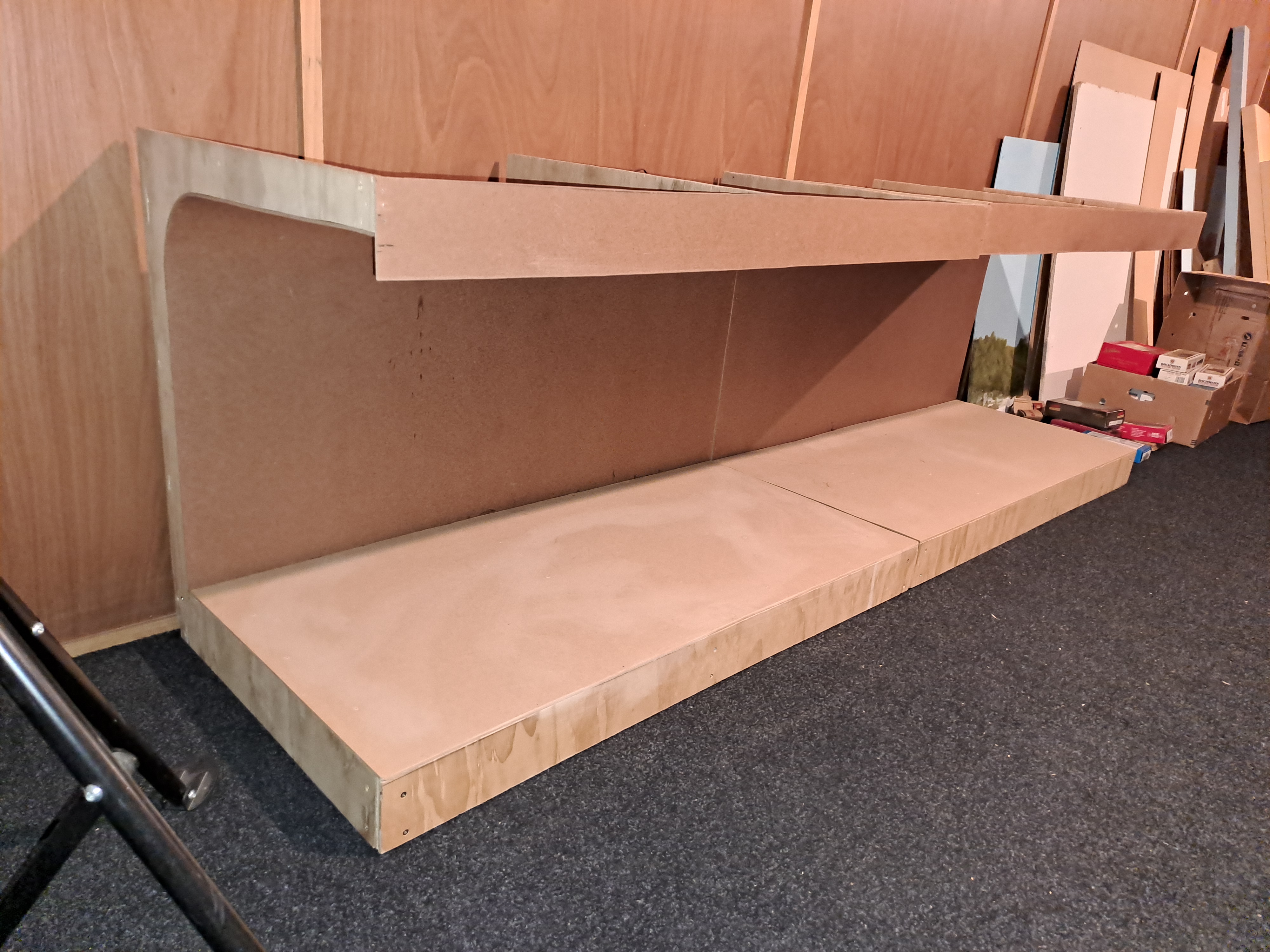
I've started chipping away on the construction of my new layout modules that will connect up with the part of the old layout I brought with me. I settled on the modules being 1200mm long x 600mm deep. 

I contemplated doing something similar to  FreeMo style modules without a backdrop. But then I found this idea from a user on the MRH forums and I decided I did really want a backdrop and in built lighting. This way, when the layout moves again, each module can be packed up relatively easily and transported as is. Maybe, I may even be able to take the modules to a train show one day. 

I've got room to build five modules in my current space. I'll share a track plan in a future post, but the priority is to build a yard area with enough capacity for all my rolling stock and locomotives, so I don't have to have any off layout storage. That way I can run trains in a point to point manner, as I did on the old Thoroughfare Gap Railroad. I'm hoping to have a roundhouse, which will be a new addition. That would go nicely with one of my turntables and engine servicing facilities. 

I've decided to minimise the grades on the layout to maximise the pulling power of the little 4-4-0's, which always tended to struggle with the steep grades on the old Thoroughfare Gap layout. That doesn't mean I won't have any dramatic scenery though. While the track height will remain mostly the same, the scenery in some modules will extend for some distance above and below the track, like it did in my redwood foreste/ravine module that didn't make the move. 

So far I've put together the benchwork on two of the modules. I'll be working away on them as I get the time over the next while. I need to make some legs and I'm thinking I'll make the track level about 125cm (49 inches) off the ground as it seems to be a comfortable height for me. How high did you decide to make your layout? If you started again would you go higher or lower?

Two modules in need of legs... (and some models).